Water lines
Kitchen and laundry water lines
Most indoor water damage does not start with a burst pipe. It starts with a supply hose that has been weeping for weeks inside a cabinet, or a washing machine hose that finally splits on an ordinary Tuesday. Those lines are short, cheap and easy to check once you know where they are.
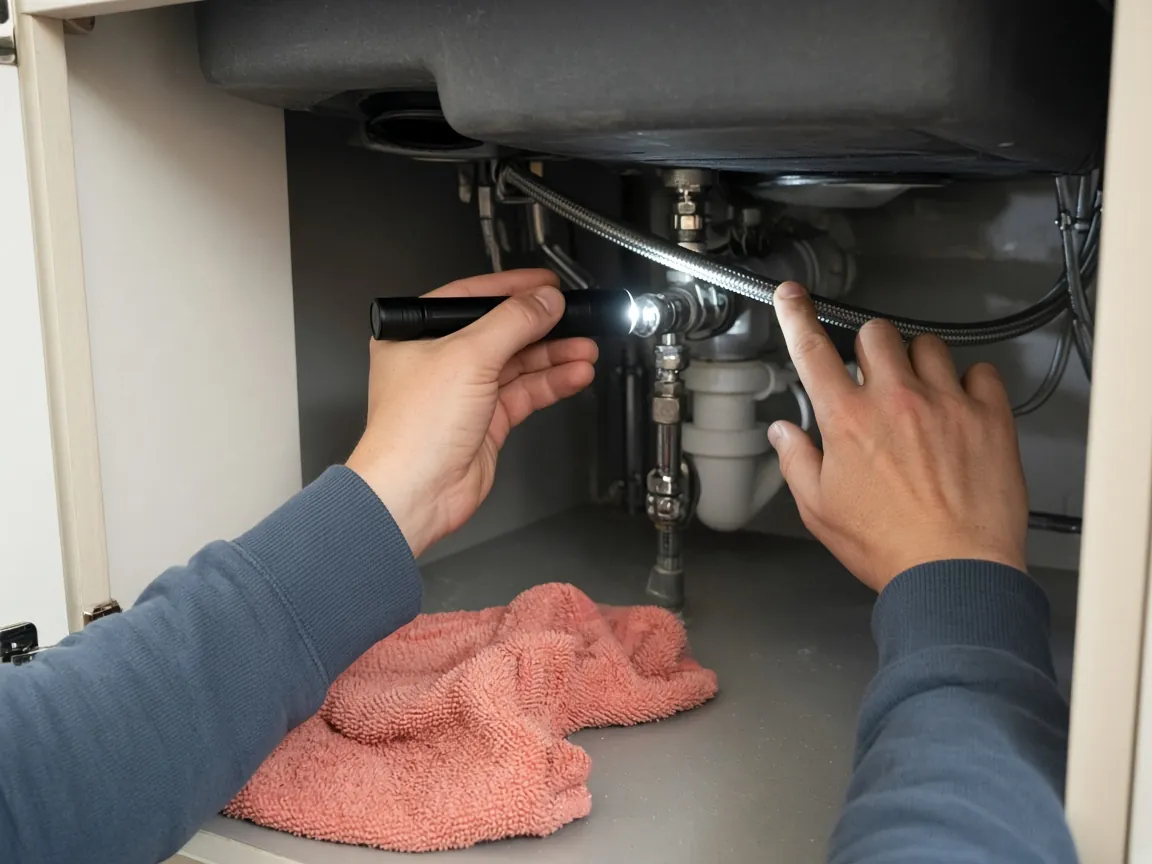
Where the short lines are
Under a typical kitchen sink there are two small shutoff valves on the wall or floor, one for hot and one for cold, each feeding a flexible supply line that runs up to the faucet. A dishwasher usually tees off the hot side with its own line that runs through the cabinet wall. If the refrigerator has an ice maker or water dispenser, a thin line runs from a valve under the sink, in the basement, or behind the fridge itself.
In the laundry area, a washing machine connects to two hose bibs or a recessed wall box with hot and cold valves. The rubber or braided hoses carry full household pressure all day, even when the machine is idle, because the valves are usually left open. That constant pressure is why washer hoses rank among the most common sources of sudden indoor flooding.
Elsewhere, look at toilet supply lines, the bathroom vanity lines, and any utility sink. All of them follow the same pattern: a small valve, a short flexible connector, and two threaded ends where leaks like to start.
How long the connectors last
Plain black rubber washer hoses are the weak link. Many manufacturers suggest replacing them about every five years, and some homeowners swap them every three. Braided stainless hoses look tougher, and they resist bursting better, but the inner tube is still rubber or plastic and still ages. Check the printed date or the paperwork, and plan to replace braided lines on a similar schedule.
Old refrigerator lines made of thin, clear or white plastic tubing can become brittle and crack, especially where they are pinched behind the appliance. A braided connector made for ice makers is a common upgrade. Faucet supply lines under sinks typically last many years but should be replaced if the coupling nuts show green or white crust, if the line has a kink, or if the braid has frayed.
Using the water meter to catch silent leaks
Many leaks never show up as a puddle. Water can drip inside a wall or seep under a cabinet floor for months. Your water meter is a simple way to see whether water is moving when nothing should be running. Most meters have a small triangle or star dial called a leak indicator that spins with even a tiny flow.
Worked example: a two-hour meter test
Before leaving for work, a household makes sure no taps are running, the dishwasher and washer are off, nobody will flush, and the ice maker is switched off. They note the meter reading: 4,512.30 cubic feet. The leak indicator is still.
Two hours later, with nothing used in between, the reading is 4,512.60 cubic feet. That is 0.30 cubic feet. One cubic foot holds about 7.48 gallons, so roughly 2.2 gallons moved in two hours, or a little over a gallon an hour.
That is enough to suspect a leak. Next they check the toilets by putting a few drops of food coloring in each tank and waiting 15 minutes without flushing; color in the bowl means a leaking flapper. If the toilets are clean, they close the shutoff valves under each fixture one at a time and repeat a shorter test. When the meter stops moving after a particular valve is closed, the leak is on that branch. A leak that keeps going with every fixture valve closed points to the pipes themselves, and that is a job for a licensed plumber.
Water pressure and why it matters
Household water pressure usually sits between 40 and 80 pounds per square inch. Pressure above 80 strains every hose and valve in the house. An inexpensive gauge that threads onto an outdoor spigot or the washer valve gives you a reading in seconds. If the number runs high, a plumber can check or adjust the pressure-reducing valve where the main line enters the house.
Quick reference
| Line | Where to look | Typical replacement | Warning signs |
|---|---|---|---|
| Washing machine hoses | Behind the washer at the wall valves | About every 5 years | Bulges, cracks near the ends, damp floor |
| Kitchen faucet supply lines | Under the sink, valve to faucet | When worn, kinked or corroded | Crusty nuts, frayed braid, warped cabinet floor |
| Dishwasher supply | Under the sink and behind the kick plate | When the dishwasher is replaced, or if damp | Drips at the kick plate, swollen flooring |
| Refrigerator water line | Behind the fridge and at its valve | Swap brittle plastic tubing for braided | Water under the fridge, a line pinched against the wall |
Water line checklist
- Open each sink cabinet and feel the floor and the lines for dampness.
- Read the dates on washer hoses and replace any older than about five years.
- Leave about four inches between the washer and the wall so hoses do not kink.
- Turn every fixture shutoff closed and open again once or twice a year.
- Find the main shutoff and make sure everyone in the house knows where it is.
- Run a two-hour meter test with all water off.
- Place battery water alarms under the sink, behind the washer and near the water heater.
Key terms
- Supply line
- The short flexible connector that carries water from a shutoff valve to a faucet, toilet or appliance.
- Quarter-turn valve
- A shutoff that closes with a 90-degree turn of the handle, as opposed to older multi-turn valves.
- Leak indicator
- The small dial on a water meter that spins whenever any water flows.
- Pressure-reducing valve
- A bell-shaped valve near the main line that lowers street pressure to a safer level for the house.
Questions people ask
Should I turn off the washer valves between loads?
Closing them takes the pressure off the hoses and is a sensible habit, especially before you leave home for a few days. Exercise the valves gently if they have not moved in years.
A valve under my sink will not turn. What now?
Do not force it with a wrench; old valves can snap. Note it, use the main shutoff if you need to work on that line, and have a plumber replace the valve.
Do water alarms really help?
A small battery alarm on the floor chirps the moment water touches it. It will not stop a leak, but it can turn a ruined floor into a wet towel.
This guide describes common household equipment. Follow the instructions on your own appliances and local codes, and bring in a licensed professional for anything involving gas, wiring or a valve that will not move.