Heating and cooling
Furnace and AC filter schedule
The filter in a forced-air system is the cheapest part of the whole setup and the one most often forgotten. A clogged filter makes the blower work harder, can leave rooms uneven, and lets dust coat the coil that does the cooling. Changing it on a schedule takes about two minutes.
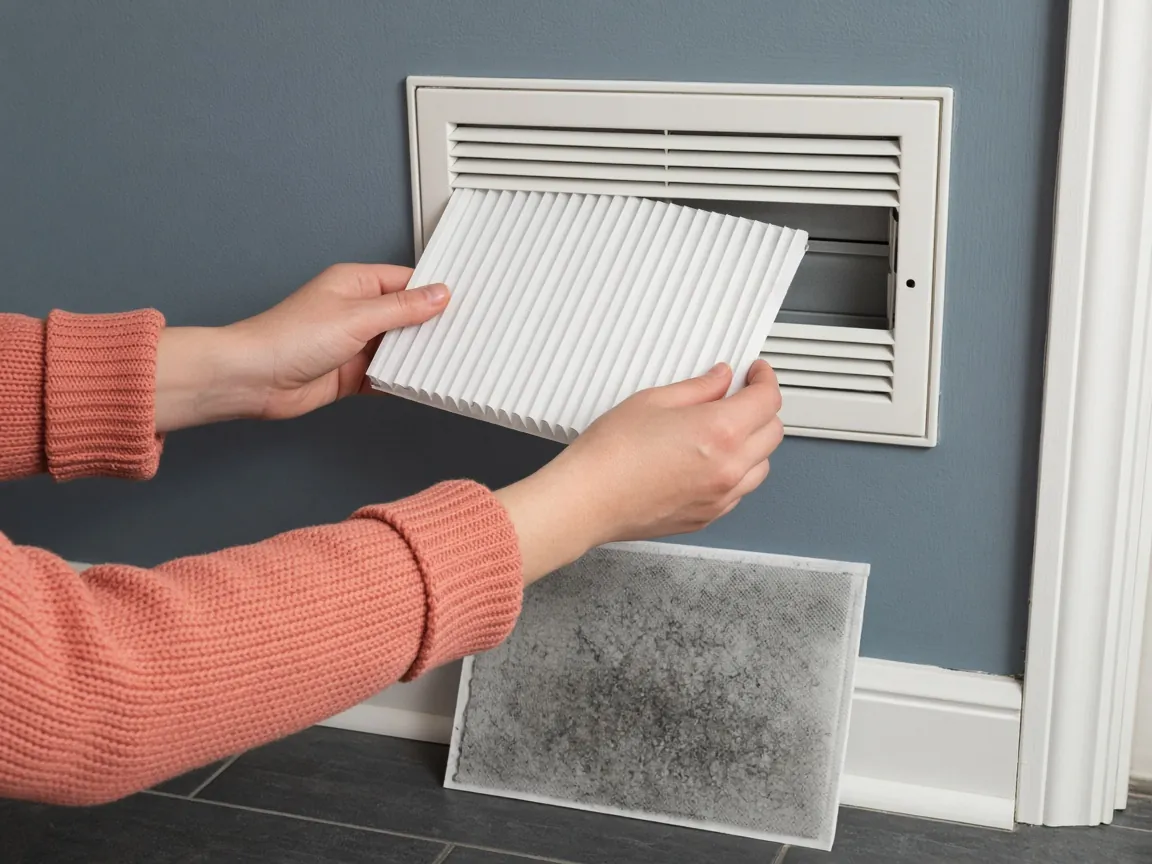
Finding the filter
Forced-air furnaces, heat pumps and central air systems pull room air back through a return, push it across a filter, then heat or cool it and send it out through the supply registers. The filter sits somewhere on that return path. In many homes it slides into a slot on the side of the furnace or air handler, often behind a removable cover. In others it sits behind a large hinged grille in a hallway wall or ceiling, which is where people most often lose track of it.
Some houses have more than one return grille with a filter in each. Walk the hallways and look up as well as down. If you find a grille with no filter behind it, check the unit itself before assuming the house has none.
Reading the size and the arrow
Every filter frame has its size printed on the edge, such as 16 x 25 x 1. Those are nominal sizes; the actual filter is a little smaller so it slides in easily. Buy by the printed size. The frame also carries an arrow that shows the direction of airflow. Point it toward the blower and away from the return grille, so the air passes through the filter the way it was built to.
Write the size and the date you installed it on the frame with a marker. The next time you open the slot, you will know at a glance how long it has been in place.
What the ratings mean
Most filters sold for homes carry a MERV rating, a scale for how well a filter catches particles of different sizes. Higher numbers catch finer dust, pet hair and pollen. For most houses, filters in the MERV 8 to 13 range are common choices. A very dense filter can restrict airflow in some older or smaller systems, so check the owner's manual or the label on the unit for the highest rating it was designed to handle.
Thickness matters as much as rating. A one-inch filter has little surface area and fills quickly. A four- or five-inch media filter, which needs a cabinet built for it, has deep pleats that hold far more dust and can run for many months.
Worked example: setting a rhythm for a busy house
A three-bedroom house has a gas furnace with central air, one 16 x 25 x 1 filter at the furnace, and a dog that sheds every spring and fall.
- The household picks a MERV 8 pleated filter, which the furnace label allows.
- Because of the dog, they plan to check the filter every month and expect to change it about every six to eight weeks, rather than the three months printed on the package.
- That works out to about seven filters a year. At roughly 9 dollars each in a multipack, the yearly cost is around 63 dollars.
- They put a filter change on the calendar for the first weekend of every other month, and keep two spares on a shelf next to the furnace so the job never has to wait for a store run.
After the first year they compare notes: the filters pulled in late spring and late fall were the grayest, so those months get an extra check.
Quick reference
| Filter type | Typical interval | Shorten the interval if |
|---|---|---|
| 1-inch fiberglass | About every 30 days | Almost always; these catch little and fill quickly |
| 1-inch pleated | Every 1 to 3 months | Pets, smokers, remodeling dust, heavy heating or cooling weeks |
| 2-inch pleated | Every 3 to 6 months | The same conditions as above |
| 4- to 5-inch media | Every 6 to 12 months | The pleats look gray across the whole face |
Filter checklist
- Find every filter location, including hallway and ceiling return grilles.
- Write the printed size and today's date on the frame.
- Install the new filter with the airflow arrow pointing toward the blower.
- Check the filter monthly during heavy heating and cooling months.
- Keep at least one spare of the right size near the unit.
- Never run the system with the filter slot empty.
Key terms
- Return grille
- The large vent that pulls room air back toward the furnace or air handler.
- Supply register
- The smaller vents that blow heated or cooled air into each room.
- MERV
- Minimum Efficiency Reporting Value, a 1 to 16 scale for how well a filter traps particles.
- Air handler
- The indoor cabinet with the blower and coil in a heat pump or central air system.
Questions people ask
Can I vacuum and reuse a disposable filter?
Pleated disposables are not built to be cleaned, and vacuuming leaves fine dust in the media. Some systems use a washable filter, which will say so on the frame.
Does a closed register save energy?
Shutting many registers can raise pressure in the ducts and make the blower work harder. Keep most of them open and unblocked by furniture or rugs.
The filter looks clean after a month. Should I still change it?
Go by the look of the filter in your house. If it is still light after a month, check again in a few weeks and adjust your schedule.
This guide describes common household equipment. Follow the instructions on your own appliances and local codes, and bring in a licensed professional for anything involving gas, wiring or a valve that will not move.